Friday, September 30, 2016

The Strategic Review, April 1976


This is the very last issue of
The Strategic Review, and the opening editor's column explains TSR's decision to create two separate magazines: The Dragon and Little Wars, as well as the expansion of each to 32 pages (although this issue already expands to 24 over the previous 16).  I love the explanation that one of the reasons for the decision was the fact that The Strategic Review had become a de facto house-organ, and TSR wanted a more generic magazine covering all aspects of fantasy and science fiction gaming.  I'm not sure they ever really achieved that, as everyone knows that Dragon is/was a house-organ for D&D (certainly by the time I entered D&D it was unashamedly so).  I'll be interested to see how that transition plays out over the course of the magazine's life.

  • The issue starts out with an article by Gygax on the magic system in D&D.  It's not quite as informative as I would have hoped, but it does explain the choice of Vancian magic for the magic system.  (Interesting side note - the concept of a mana-based magic system was still a decade away.  Wikipedia says that the PC game Dungeon Master was the first game to include it.)  It also explains Vancian magic, as apparently many players did not understand the concept of spells having to be memorized and used up (which I can't blame them, given the very loose writing of the original boxed set).  Gygax also states that there is no intention to add any spell levels beyond 9th, a decision which codified an aspect of the game for decades to come.
  • While not D&D related, there's another humorous editorial on TSR's spat with Avalon Hill over which gaming convention is THE national convention - GenCon or Origins.  Then, in the first ever letter column, the very first letter goes to Gary Gygax, who writes even more about this issue!  Apparently TSR really had a chip on its shoulder over this.
  • The very first artifact for the game makes its appearance: the Cup and Talisman of Akbar ("Al'Akbar" in later material).
  • There's a brief table given without context that introduces adjustments to thief skills based on dexterity.  It also attempts to give thieves exceptional dexterity analogous to fighters' exceptional strength.
  • Gygax has another article basically shaming Monty haul DMs (although that term doesn't actually appear), saying they're not playing real D&D.  I have mixed feelings about this.  On the one hand I agree with him, as it's out of the spirit and intention of the game, but I'm also a big believer in people playing games the way they want to play them - if they enjoy the Monty haul style, more power to them.  Ultimately I think games should establish what "normal" play looks like, but ultimately rules should be our servant, not our master.
This issue also contained an ad for the about-to-be-released Eldritch Wizardry supplement, and that's where our archaeological expedition takes us next.  I look forward to seeing you there.

Thursday, September 29, 2016

The Strategic Review, February 1976


Another two months, another issue:
  • Gary Gygax has an article expanding the alignment concept.  Up until now there has only been Law and Chaos, but now he adds the orthogonal axis of Good and Evil.  This thus creates five distinct alignments: lawful good, chaotic good, chaotic evil, lawful evil, and neutrality.  The in-between neutral alignments are yet to appear, however, the pictorial illustration nevertheless gives the names of the eight outer planes associated with all eight non-neutral alignments: heaven, paradise, elysium, limbo, the abyss, hades, hell, and nirvana for lawful good, neutral good, chaotic good, chaotic neutral, chaotic evil, neutral evil, lawful evil, and lawful neutral respectively, even though NG, CN, NE, and LN are not discussed as character alignments.  Not only are we witnessing the evolution of the concept of alignment in D&D, but we also get our very first glimpse of the development of the outer planes.
  • The bard class is introduced.  The author admits that the class is an amalgamation of the nordic skald, the celtic bard, and the European minstrel from history.  The basic concepts of the class are all here, although the details are significantly different from later incarnations.  Bards don't learn spells like wizards, but instead collect magical instruments that allow them to cast certain spells.  Instead of having a song that increases party morale, the bard's song charms others.  Thieving and lore abilities appear as well, although again, the details are somewhat different.  What interests me most about the new classes being added to the game (all of which end up becoming staples of D&D and roleplaying in general) is that some are being created by non-TSR authors.  This was true of the illusionist class and now the bard class as well.  These are just fans of the game submitting their ideas to the magazine, having no conception of the legacy they're creating.  Can you imagine writing an article forty years ago simply out of a love for the game and a desire to contribute to it, only to have it cement our notions of canonical classes in modern day RPGs?
Most of the rest of the content is devoted to board games, miniatures, and other things (such as the very first fiction story in the magazine - something that will become a regular feature), so with that, I'll call it a day.

Tuesday, September 27, 2016

The Strategic Review, December 1975


The magazine went to a bi-monthly publishing schedule with this issue, no doubt as TSR continued to pick up steam as a company and had more news and content to put out.  It also saw yet another increase in size - from 12 to 16 pages.  What do we get in all that space?

  • There's an interesting article where the various famous personalities of TSR (Gary Gygax, Brian Blume, Timothy Kask, etc.) give their own bios.  As I said early in this blog, my focus is on the history of D&D rather than the history of TSR.  Nevertheless, I do find this info interesting - to know a little more about the original minds behind the game.
  • There's an article describing a miniatures game where the referee secretly pitted a German unit from Tractics against a unit of D&D monsters without either side's foreknowledge - each side thought they were going to play a standard WWII or fantasy miniatures battle respectively.  It's an interesting read and reflects on the philosophy of D&D (even though this was a miniatures game) at this point.  There's definitely a lighthearted sense about the game, and DMs are not afraid to throw out-of-genre material into their campaigns.  All in all, the game doesn't take itself too seriously.  I see this as an outgrowth of the lack of story-based roleplaying that I've been discussing - if there's no real story to worry about, then there's no need to worry about verisimilitude and consistency.
  • There's an article (an editorial, really) that pretty much involves TSR whining about rival company Avalon Hill.  AH had recently started the Origins wargaming convention, and apparently in some of their marketing had referred to it as the "premier" wargaming convention, and the only "national" convention.  The article goes to great lengths to explain that GenCon (having completed its eighth year) is in fact THE national wargaming convention.  It reminds me of the article Gygax wrote an issue or two ago taking some game reviewer to task over his negative review of D&D.  Apparently the TSR folks had a chip on their shoulder when it came to their reputation.
  • Besides some new creatures and new magic items there wasn't a lot of D&D content in this issue, so I'll stop here and move on to the next.  However, I haven't been giving much artwork lately, so I'll leave you with this jewel:

The Strategic Review, Winter 1975


Let's see, what did we get in the latest Strategic Review:


  • Even more polearms!  Apparently Gary Gygax felt he hadn't exhausted the topic in the last issue, so we get another article discussing more varieties.  I'm sorry, I get it from a wargaming perspective, but from a roleplaying perspective it's just funny to me.
  • The first ad for the Dungeon! game appears in this issue.  I've never played it (or even seen it), but I would be interested, because material elsewhere makes it basically seem like a board game version of D&D.
  • The upcoming relaunch of TSR's magazine line with The Dragon is teased in this issue.  There's no context or explanation that that's what's happening, just a box with the line, "The Dragon is coming!"
  • The illusionist is detailed as a new class for D&D.  Being only familiar with specialist wizards in 2nd edition, I was not aware that previously the illusionist was actually its own class.  All new illusionist spells are detailed here, most all of which ended up becoming regular mage spells (in the illusion school, of course) in later editions.  I'll be interested to see down the road if there's any informative material on the switch to the specialist concept, and why the same concept was not applied to paladins and rangers, for example, making them "specialist fighters".
  • Finally, the article that readers have been begging for ever since the magazine launched - a detailed etymology of Tsolyani names!  What in the world is that, you ask?  It's a fictitious language from the Empire of the Petal Throne roleplaying game, which I've never personally encountered but would be interested to learn more about.  The setting sounds fascinating - a post-apocalyptic "future past" type setting where a previously highly technological society has degenerated down to primitive technology and magic.  However, if you've ever struggled through the appendices to The Lord of the Rings, you know that nothing says tedium like a detailed phonetics lesson on a made-up language.
  • A truly classic D&D magic item is introduced here - ioun stones (although technically they were borrowed from Jack Vance's novels).  I've always loved the idea, although sadly none of my D&D characters have ever gotten to possess one.

Supplement II: Blackmoor

Authors: Dave Arneson
Artists: Dave Sutherland, Mike Bell, and Tracy Lesch

Ah, Blackmoor - a strange beast of a supplement if there ever was one.  Released in September of 1975, the supplement continues the format of Greyhawk in separating its content into additions and clarifications to the three books of the original boxed set: Men and Magic, Monsters and Treasure, and Underworld and Wilderness Adventures.  What sets this book apart though is the devotion of almost entirely the third section (and nearly half of the book) to a thorough detailing of a section of Dave Arneson's Blackmoor campaign.  It's fascinating because Blackmoor was the first and oldest D&D campaign in existence, so we get to see a glimpse of what one of the creators of D&D thought the game should look like.  It does make for a somewhat odd supplement, however, being half rules and half adventure module.


This supplement introduces the infamous monk and assassin classes.  These classes always seemed especially polarizing to me - people either loathed them or missed them terribly in 2nd edition.  When I started up my own 2nd edition D&D campaign one of my players tried to convince me to allow him to roll a monk under the 1st edition rules (I declined).  Seeing them in their original context, the monk seems to me to be another quadratic character like wizards - feeble at low levels, but increasing exponentially in power as they level up and attain their special abilities: ridiculous attacks and damage with unarmed strikes, a fighter-like AC, and a ludicrous number of immunities.  As for the assassin, I'm not really sure what the thought process was for them - they're basically weaker thieves who can undertake assassination missions for gold and XP.

This supplement tries to introduce a hit location system to the rules, which obviously never had a lasting impact.  Now I admit I am a simulationist and like my RPGs to be as realistic as possible, so I like this sort of thing - in theory.  In reality, I and most other people never play with it because it just requires too much bookkeeping and causes combat to grind to a halt.

The section for new monsters and treasures is bizarrely focused exclusively on an undersea theme with no explanation as to why.  I guess Arneson's campaign had a lot of undersea excursions?  Nevertheless, we do get some more classic D&D monsters like the sahuagin and the ixitxachitl (and on a side note, if you can spell either of those words without looking them up, you know you've been playing D&D too long).

Finally, we get to a lengthy description of the Temple of the Frog, a location in Arneson's Blackmoor campaign.  It's really a prototype for the first modules TSR would release.  It gives a brief backstory for the location, then proceeds into multiple keyed maps describing it in minute detail for exploration purposes.  There's no "adventure" per se - unlike modern modules which have an unfolding story, this just gives a static description of the location.  It's only purpose is to be systematically explored and looted, which fits with the hack-and-slash philosophy of the game we've been discussing.

This was a slightly offbeat supplement to be sure.  We're at an odd point here in the history of TSR - only one product was released every few months or so as the company got going, as opposed to later years in which multiple products would be released every month.  So join me next time as we dive back into some issues of The Strategic Review.

Monday, September 26, 2016

The Strategic Review, Autumn 1975


By all that is holy, I didn't think they could make the type they used for the magazine any smaller, but they found a way.  I understand they were trying to save on printing costs by keeping the page count down, but this is ridiculous.  You would have either had to use a magnifying glass or settle for an eye strain-induced headache to read this back in the day.


The opening editorial consists of Gary Gygax making some rather pointed comments about another game designer who had apparently given a bad review of Dungeons and Dragons.  The article is notable for the rather snippy and defensive tone Gary uses, which is a bit surprising, as I have always read that Gary was a rather easy-going guy.  But I guess we all get a little defensive when someone attacks our (brain)child.

This months' Creature Features brings us a couple of staple D&D creatures like the shambling mound and the ghost (not that the ghost is unique to D&D, but it's characteristic aging attack is and appears here from the beginning).  Also included are the piercer and the lurker above, two creatures which I feel very much represent the design philosophy of the game at this point.  The piercer looks just like a stalactite, and the lurker above is a large manta ray that looks just like a cave ceiling.  When something walks beneath them, they fall on them, stabbing them or smothering them respectively.  They're basically designed to be undetectable traps.  Both are somewhat ludicrous when considered as actual creatures with a biology and ecology, but this represents the philosophy - make the game harder for players by any means necessary and don't worry about reality.

The rest of the issue has remarkably little D&D-related, but has articles on Napoleonic warfare, old west gun fighting (in preparation for TSR's Boot Hill), and the layout of Martian cities based on John Carter of Mars.  It represents a brief moment of history when TSR (and the magazine) really were multi-faceted, before the wild success of D&D overshadowed all else.

Next post we get back into actual books, with Supplement II: Blackmoor.  Until next time.

The Strategic Review, Summer 1975


The second issue of The Strategic Review expanded a whopping 33% over the first issue - from 6 pages to 8!  What took up all this new space?
  • The issue starts off with a dedication to Donald Kaye, who had recently passed away.  Kaye was a co-author of the Chainmail rules and co-founder of TSR.  When you read about the history of D&D, TSR, or roleplaying games in general you always hear plenty about Gary Gygax and Dave Arneson, but very little about Donald Kaye, no doubt due to his early death.
  • The first ever D&D rules FAQ appears (although it's actually called "Questions Most Frequently Asked", as the term "FAQ" had not been invented yet).  It's not really a FAQ so much as it is a list of clarifications, which is not surprising given the vague and loose manner in which the original boxed set was written.  Most of the content isn't all that interesting, except for the part clarifying the Vancian nature of magic.  The boxed set seemed to take this point for granted, as if everyone had read the Dying Earth series and understood how magic worked.
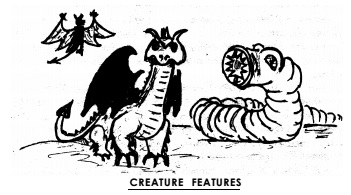
  • The Creature Features article for this issue features the roper - a classic, if perhaps not iconic, D&D monster.  What's more interesting about this article is the decorative art: 
    Quality fantasy art was still a few years away
  • The ranger is introduced as a new class for the game.  I was a little surprised the ranger was not part of the original rules, considering how heavily they borrowed from The Lord of the Rings in the first place.  Most of the essentials are here - tracking ability and fantastic followers, for example.  A few oddities that were dropped in the course of history are worth mentioning though:
    • Rangers below 8th level got a 33% boost to their experience for some reason.
    • Rangers originally received both cleric and mage spells at higher levels.
    • If you rolled well enough on the special follower table, you could have a gold dragon as a follower.
  • There's an extensive article (with illustrations!) by Gygax on the various types of medieval polearms.  I remember when I read the 2nd edition Player's Handbook for the first time wondering why it went into such detail on all these historical polearms that I had never heard of before.  After all, did you ever know a fighter who actually took proficiency in the guisarme-voulge?  Now that I understand D&D's wargaming roots better it makes much more sense.
I hope you enjoyed another walk down memory lane.  Issue 3 is up next.